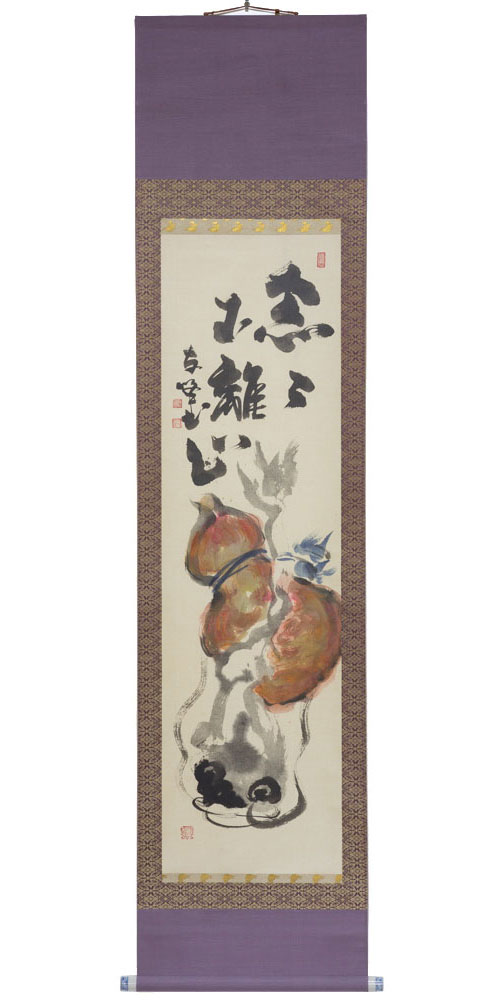
The saying, “Thought after thought is not separate from mind,” comes from a short text, often chanted in Zen temples in Japan, known as the Ten-Phrase Kannon Sūtra十句觀音經
Japanese: Jikku kannon gyō
. The last four phrases read:
In the morning think of Kanzeon,
in the evening think of Kanzeon.
Thought after thought arises from mind;
thought after thought is not separate from mind.
| 朝念觀世音
暮念觀世音
念念従心起
念念不離心
|
To “think of”念
Kanzeon (a.k.a. Kannon觀音
) means to pray to that powerful, compassionate bodhisattva for help. From the Zen point of view, there is a certain futility in that activity because, after all, Kannon is only an imaginary being, and it is deluded to think that one’s own spiritual salvation might come from outside. Nevertheless, if one realizes that the successive thoughts念念
that arise from the mind in prayer are “not separate from mind”不離心
, that is tantamount to intuiting one’s own innate buddha-mind, which is awakening. Paradoxically, then, the prayer to Kanzeon can actually work.
Gourd and Catfish (hyōnen-zu 瓢鯰図)
This painting plays off a famous “image of gourd and catfish”瓢鮎図
Japanese: hyōnenzu
, produced by Josetsu如拙
sometime before 1415, that is owned by a sub-temple of the Zen monastery Myōshinji in Kyoto and is designated a National Treasure. Josetsu’s painting shows a man standing on a river-bank, aiming to catch a swimming catfish鮎
Japanese: namazu
with a gourd瓢箪
Japanese: hyōtan
that he holds in his hands. The futility of that attempt is obvious, but the shape and bearing of the gourd in the painting, which mirrors that of the fish, makes it a simulacrum. The point is that one cannot gain actual awakening悟り
Japanese: satori
by means of the intellectual concept of “awakening,” although the latter does bear some resemblance to the former.
Master Takahashi uses the saying, “Thought after thought is not separate from mind,” to indicate that the deluded idea of awakening (symbolized by the “gourd” in the painting) occurs in the very same mind that may attain actual awakening (the “fish” in the painting). His painting, too, juxtaposes the gourd and the catfish in a much more intimate way than the painting by Josetsu. In fact, his gourd looks like it may have actually caught the fish!
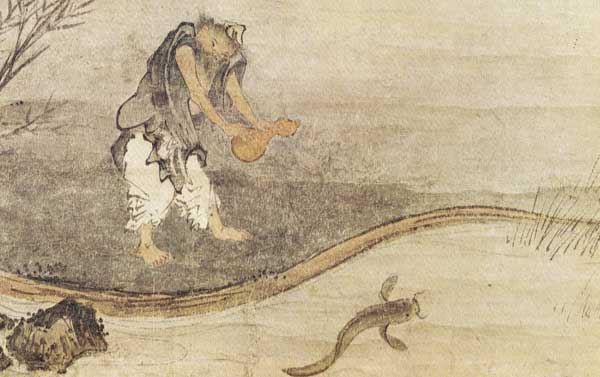
Image of Gourd and Catfish