“A Single Flower”

Inscribed Zen Saying
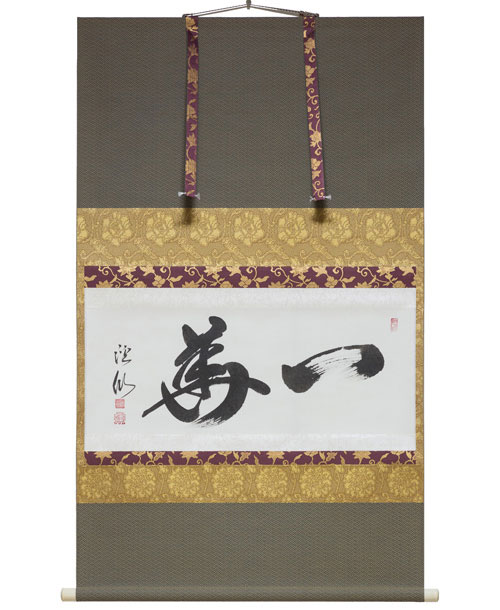
一華
Chinese: yi hua
Japanese: ichige
Translation: “A Single Flower ”

Gist of Saying
The expression “a single flower” alludes to a famous legend about the founding of the Zen lineage in India and its subsequent flourishing in China. On one occasion, the Buddha Śākyamuni is said to have simply held up a flower in lieu of a verbal sermon. The only person in the vast audience who intuited his meaning was his disciple Mahākāśyapa, who smiled faintly in response. The Buddha named him heir to the “signless” buddha-mind (awakening), which was subsequently transmitted through a single line of twenty-eight Indian and six Chinese ancestral teachers, after which the lineage ramified into five main branches. Bodhidharma, the Indian patriarch who brought Zen to China, is said to have prophesied that “A single flower will blossom with five petals.”一華開五葉
Japanese: ichige kai goyō

See full explanation ↓ 

Description of Item
・Hanging scroll (kakejiku 掛軸) with calligraphic Zen saying (ji 字), artist’s signature and seals (in 印)
・Horizontal (yokomono 横物) style (lateral inscription, reads right to left)
・Overall dimensions: 27 inches x 46 inches (69 cm x 117 cm)
・Hand mounted using gold-embroidered damask silk brocade (kinran donsu 金襴緞子)
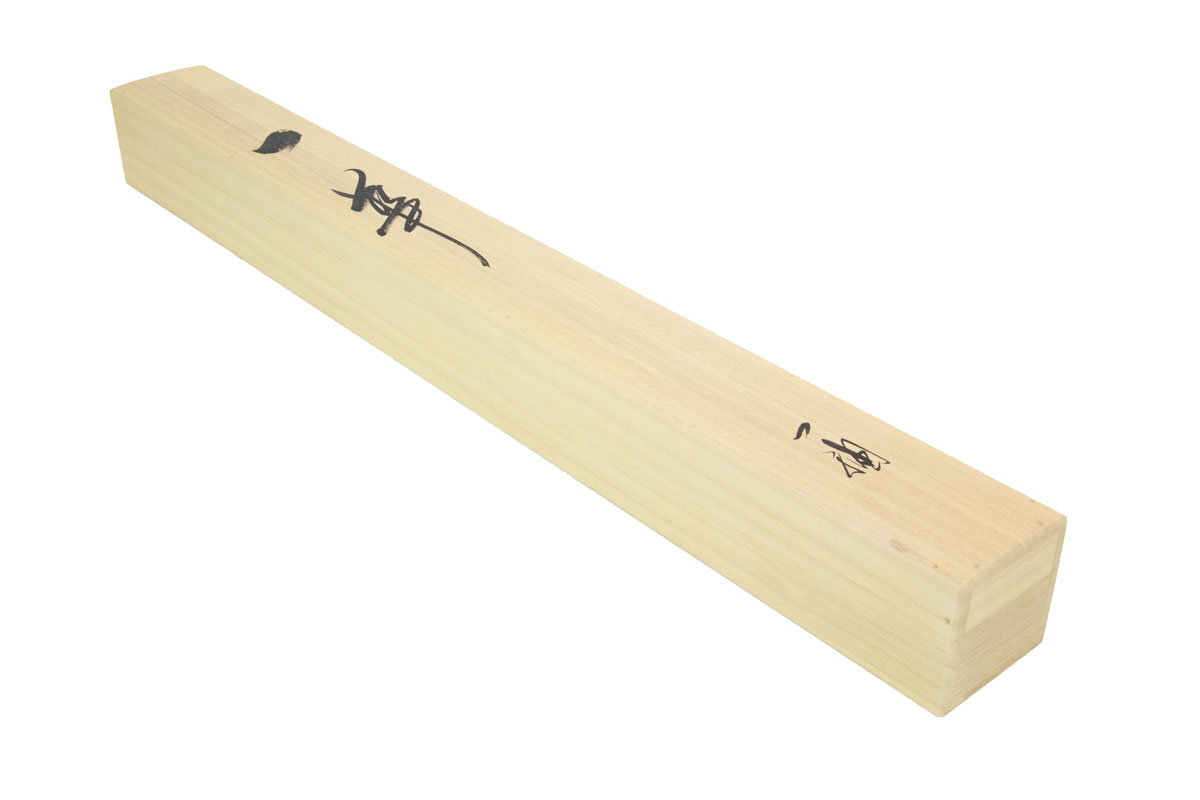
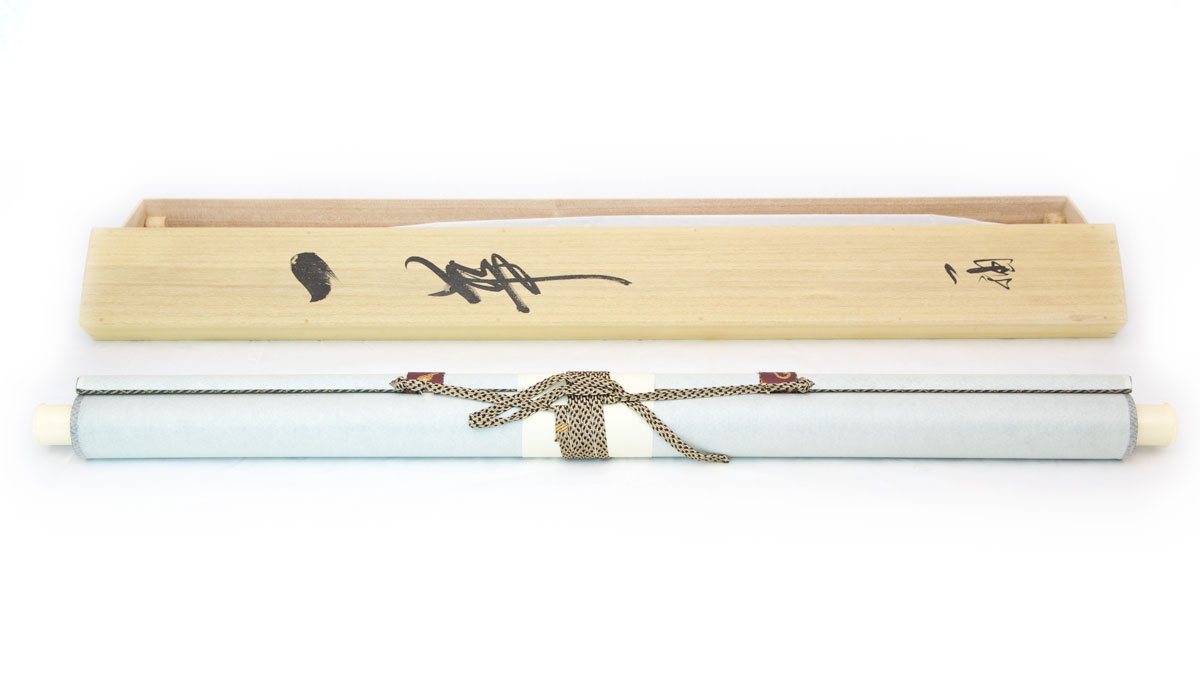
・Comes in paulownia wood (kiri 桐) storage box, inscribed by artist


$1,700.00

Available

SKU: 5296 Category: Tags: ,

The story in which the Buddha Śākyamuni “held up a flower” to give a wordless sermon first appears in the Tiansheng Era Record of the Spread of the Flame天聖廣燈録
, compiled in 1036:

When the Tathāgata was preaching the dharma on Vulture Peak, the devas made offerings of flowers to him. When the World-Honored One held up a flower to instruct the assembly, Kāśyapa smiled faintly. The World-Honored One announced to the assembly, “I have the treasury of the true dharma-eye, the inconceivable mind of nirvāṇa, which I bequeath to Mahākāśyapa. He should spread it and not allow it to be cut off in the future.”

如來在靈山説法。諸天献華。世尊持華示衆。迦葉微笑。世尊告衆曰。吾有正法眼藏。涅槃妙心。付囑摩訶迦葉。流布將來。勿令斷絶。

Mahākāśyapa, according to this tale, was thereby established as the first in a line of twenty-eight ancestors of the Zen lineage in India, the last of whom, Bodhidharma, transmitted it to China. Bodhidharma is said to have selected his disciple Huike慧可
 as his main spiritual heir, saying:

Long ago the Buddha took the true dharma eye and bequeathed it to Kāśyapa the Great One. It was subsequently transmitted many times until it came to me. I now entrust it to you. You must protect it.

昔如來以正法眼付迦葉大士。展轉囑累而至於我。我今付汝。汝當護持。并授汝袈裟以為法信。

Bodhidharma also made a prediction that, “two hundred years after my death, the dharma will spread throughout myriads of realms,” and he spoke the following verse for Huike:

I came to this land, fundamentally,
to transmit the dharma and save deluded beings.
A single flower will blossom with five petals,
and the fruit will be produced of its own accord.

吾本來茲土
傳法救迷情
一華開五葉
結果自然成

The “single flower” mentioned here is the flower held up by the Buddha Śākyamuni when he founded the Zen lineage. The “five petals” are an allusion to the “five houses”五家
of Zen: the five main branches of the lineage that are said to have emerged in the generations following the sixth ancestor Huineng慧能
: Weiyang潙仰
, Linji臨濟
, Caodong曹洞
, Yunmen雲門
, and Fayan法眼
.
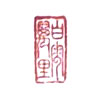
Calligraphic Signature

“Keisen” (渓仙)
Keisen is Master Takahashi’s ordination name.

Comment Seal

“White Clouds for 10,000 Leagues” (hakuun manri 白雲萬里)
A metaphor for an awakened state of mind that remains serenely detached even in the midst of its own thought processes, which float by like clouds.
In-Hakuun-Manri

Signature Seals

“Keisen, Monastery Abbot” (Keisen sanshu 渓仙山主)
Keisen is Master Takahashi’s ordination name.
In-Keisen-Sanshu
“Yūhō” (友峰)
Yūhō is Master Takahashi’s personal name
In-Pot

Blarga