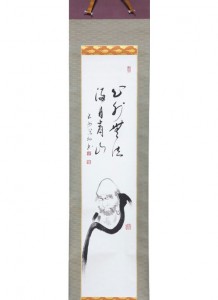
This is a famous saying attributed to the Chinese Chan (Zen) Master Yunmen Wenyan雲門文偃
(864-949) in the Extensive Record of Chan Master Yunmen Kuangzhen雲門匡真禪師廣錄
:
Addressing the assembly of monks, the master said: “I am not asking you about what comes before the fifteenth day, but try to say a few words about what comes after the fifteenth day.” Answering in their stead, he said: “Every day is a good day.”
示衆云、十五日已前不問爾、十五日已後道將一句來。代云、日日是好日。
This passage also appears as case #6 in a famous kōan collection, the Blue Cliff Record碧巖錄
.
Some scholarly interpretations of Yunmen’s saying hinge on the fact that, in the Buddhist monastic tradition conveyed from India to China, the fifteenth day of the month (in the lunar calendar) was a day of “observance”布薩
Japanese: fusatsu
on which all the monks in a given monastery would gather to confess any individual transgressions of moral rules established in the Vinaya and thereby achieve the ritual purification of their community.
The commentary on Yunmen’s saying found in the Blue Cliff Record, however, makes no mention of that monastic observance. It notes, rather, the obvious fact that what comes after the fifteenth day of any month is the sixteenth day, and it scoffs at that common-sense response as one that entirely misses Yunmen’s point. What Yunmen is getting at, probably, is the disjunction between the conceptual categories that we use to organize our lives and the world as it exists in and of itself. After all, the calendar with its numbered “days,” “months” and “years” is an abstract, intellectual construct. The saying, “Every day is a good day,” urges us to bracket (not abandon, but see through) our conceptual constructs and directly experience the present day (i.e. moment) of being alive.