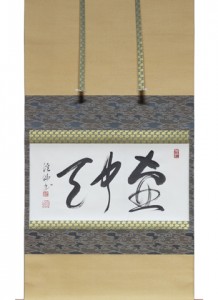
In ordinary Chinese and Japanese, the word 夢Chinese: meng
Japanese: yume
functions both as a verb meaning “to dream” or to “see visions,” and as a noun meaning “dream,” “vision,” “wishful thinking,” or “illusion.” It can also function as an adjective or adverb, in which case it has the sense of “foolish(ly)” or “vain(ly).” In many contexts, “dreaming” has the negative connotation of being a state of mind that is out of touch with reality. However, in Confucian, Daoist, and Buddhist literature there is also a tendency to regard dreams and ecstatic visions as a valuable opening to a world of spiritual beings, both benevolent (e.g. buddhas and bodhisattvas) and malevolent (e.g. hungry ghosts), that is closed off to ordinary waking consciousness.
In Buddhism, the very idea of a buddha or “awakened one” employs the metaphor of waking from a dream and realizing that what one has just experienced in it is not real. According to Buddhist philosophy, ordinary living beings are in a state of delusion concerning reality, as if they were living in a dream, while buddhas have come to see things as they really are.
In the Zen Buddhist tradition, awakening is not understood as the complete absence of “dreaming” or delusion, but rather as an insight into the fact that one’s mental life is inherently and ineluctably “dreamlike.” That is because language, the vehicle for much of our thought, works by naming “things” that do not actually exist in the ways that we imagine. As Zen master Dōgen道元
(1200-1253) says in a famous work entitled “An Obvious Case”現成公案
Japanese: Genjō kōan
:
Those who greatly awaken to delusion are buddhas;
those who are greatly deluded about awakening are ordinary living beings.
迷を大悟するは諸佛なり、
悟に大迷なるは衆生なり。
In other words, to “awaken to delusion” is to see dreaming clearly for what it is, even while involved in it.