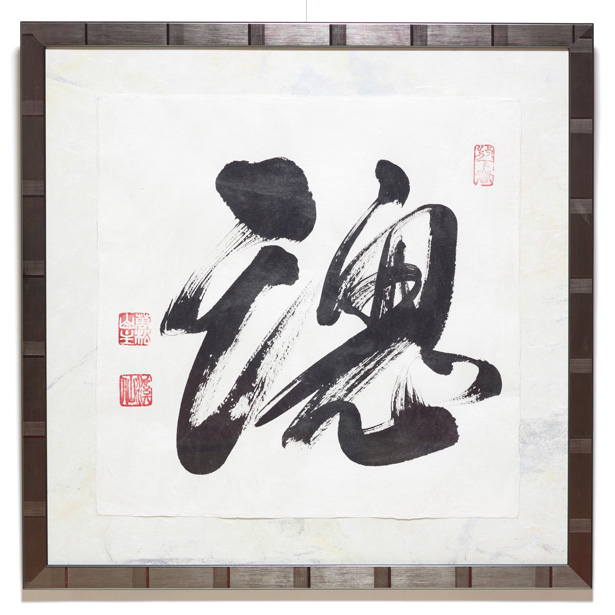
In ancient Chinese thought, the word hun (魂) referred to the “higher spirit,” the heavenly part of the human soul, which was believed to be unattached to material things and to develop in the latter part of a person’s life. It was paired with the po (魄) or “lower spirit,” the animal part of the human soul, which was said to develop in the earlier part of life. When a person died, the po would go to the earth with their body, while the hun would survive independently as an ancestral spirit. The latter was given a place to reside in a tablet牌
, kept in a family mortuary hall, and nourished with regular offerings of food and drink.
In later Chinese and Japanese, the idea of a paired “higher” and “lower” spirits was largely forgotten, but the word hun魂
Japanese: tamashii
retained its basic meaning as the “spirit” of a dead person, conceived as a being who no longer has a physical body but retains his/her identity and set of familial relationships with the living. Ancestral spirits are generally benevolent, but spirits of the dead who have no descendants to care for them can become pitiful, vengeful, and dangerous “wandering ghosts”遊
or, in Buddhist terminology, “hungry ghosts”餓鬼
.
Zen monks all over East Asia routinely perform memorial rites in which they offer nourishment供養
to spirits of the dead, including (1) ancestral teachers祖師
in the Zen lineage, (2) the ancestors of lay patron families檀家
, and (3) all “disconnected”無縁
and dangerous spirits.
Standing alone as it does in the present work of Zen calligraphy, however, the word “spirit” is best interpreted as the “life force” or “animating spirit.” It is something akin to what, in modern terms, is called the “autonomic nervous system”: an active principle that keeps us alive (breathing, heart pumping, etc.) even when asleep, unconscious, or otherwise oblivious to those basic functions. Zen teaches that human beings are so caught up in linguistic constructs and conceptual thinking that we lose sight of the underlying “spirit” or “buddha nature”佛心
that is the very essence our own lives. To bring that “spirit” back into view is to see through delusional ideation and reconnect with the immediate reality of our existence.