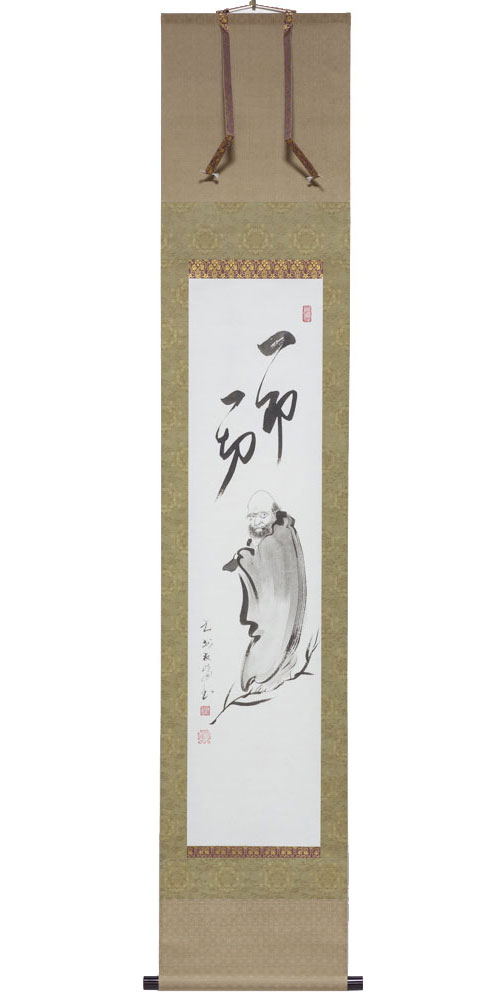
The expression “One is everything” comes from a short text entitled Inscription on Faith in Mind信心銘
, ascribed to the third patriarch of the Zen lineage in China, Sengcan僧璨
. The text ends as follows:
What exists does not exist, and what does not exist exists. Whatever ideas we have that do not accord with this [principle] should certainly not be adhered to. One is everything; everything is one. If only we can be like this, what worries could we have about being incomplete? Faith in mind is non-dual, and non-duality is faith in mind. When the way of language is cut off, we are not in the past, future, or present.
有即是無無即是有。若不如此必不須守。一即一切一切即一。但能如是何慮不畢。信心不二不二信心。言語道斷非去來今。
According to the doctrine of “emptiness”, there are no “things”法
that exist in and of themselves, independently of everything else. It is only the “way of language,” the naming of things, that interferes with the “completeness”畢
of the innate buddha-mind.
Bodhidharma (Darumazu 達磨図)
Bodhidharma菩提達摩 or 菩提達磨
Chinese: Putidamo
Japanese: Bodaidaruma
was an Indian Buddhist monk, a meditation master who was active in China in the early sixth century and came to be revered as the founding patriarch初祖
of the Zen lineage禪宗
in that country. Very little is known about the historical Bodhidharma, but his legendary biography grew in detail from the eighth through the eleventh centuries, and he became an emblematic figure much invoked thereafter in Zen literature and art.
According to traditional accounts, the Zen lineage was founded when the Buddha Śākyamuni conveyed his awakening — his “subtle mind of nirvāṇa”涅槃妙心
, which is “signless”無相
— directly to one of his disciples, the monk Mahākāśyapa, in what is characterized as a “separate transmission”別傳
that took place “apart from the teachings”教外
of the sutras. Mahākāśyapa later transmitted the “buddha-mind”佛心
to another monk, Ānanda, who became the second patriarch of the Zen lineage in India. The “mind-dharma”心法
, as it was also called, was subsequently handed down from master to disciple through the generations until it reached Bodhidharma, the 28th patriarch, who was charged by his master Prajñātāra (the 27th) with transmitting it to China.
The lore about Bodhidharma’s career in China includes many famous incidents. He is said to have “come from the west” by sea, arriving in 527 C.E. He immediately had an audience with Emperor Wu of the Liang dynasty (502-557), whose avid patronage of Buddhist institutions he characterized as “having no merit”無功徳
. He then took up residence in the Shaolin Monastery少林寺
near Louyang, capital of the Northern Wei dynasty (386-535), where he spent nine years in meditation “facing a wall”面壁
. The monk Huike came to that monastery and was so ardent to be accepted as Bodhidharma’s disciple that he cut off his own arm斷臂
as an offering and was immediately instructed concerning true “peace of mind”安心
. Before returning to India, Bodhidharma recognized Huike as the second patriarch of the Zen lineage in China, stating that while other disciples had attained his “skin”皮
, “flesh”肉
,” and “bones”骨
, only the latter had “attained his marrow”得髓
. Bodhidharma, it is said, “only transmitted the mind dharma”唯傳心法
, no other teaching. With regard to his own method of instruction, he is often quoted as saying: “I point directly at the human mind吾直指人心
[so people may] see its nature and attain buddhahood見性成佛
,” and, “My method is to transmit mind by means of mind以心傳心
, without relying on scriptures不立文字
.”
Formal portraits of Bodhidharma (and all later patriarchs in his lineage) were first produced in Chinese Zen monasteries for use in annual and monthly memorial rites, when offerings of food and drink were made to those ancestral spirits. Later, all across East Asia, Bodhidharma also became an extremely popular subject of ink paintings inscribed with Zen sayings and used for decorative and didactic purposes. In keeping with his identity as an Indian monk, a “barbarian” from the west, he is conventionally depicted as a swarthy figure with a beard, earring, big nose, bulging eyes, and hairy chest. This ink painting by master Takahashi shows Bodhidharma “crossing the Yangzi River on a single reed”一葦於長江
, a miraculous event in the legendary life of the founding patriarch that is said to have occurred on his way to the Shaolin Monastery, after he left Emperor Wu.