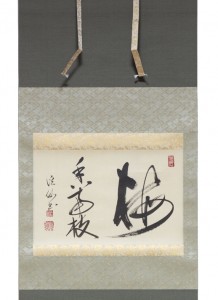
The saying, “Not a single thing exists”無一物
Chinese: wu yi wu
Japanese: mu ichi motsu
is famously attributed to the sixth ancestor of the Zen lineage in China, Huineng慧能
, in a work known as the Dharma Treasure Platform Sūtra of the Sixth Ancestor祖大師法寶壇經
. According to that text, the fifth ancestor, Hongren弘忍
, staged a public poetry contest at his monastery to determine his successor. The head monk Shenxiu神会
, widely presumed to be the heir-apparent, submitted the following verse:
|
|
Huineng, who at the time was an illiterate lay postulant serving as a laborer in the monastery, realized the deficiency of this verse when it was read to him and voiced a poem of his own in response:
|
|
On the basis of these verse, the fifth ancestor is said to have chosen Huineng over Shenxiu as his successor.
Shenxiu’s verse alludes to the necessity of practicing meditation in order to eliminate the “dust” of greed, anger, and delusion: afflictions that obscure the “bright mirror” of the buddha-mind that all living beings are endowed with. Huineng’s verse, with its core declaration that “not a single thing exists,” invokes the Mahāyāna Buddhist doctrine of emptiness (śūnyatā), which holds that the world does not really consist of quasi-static, separately existing, self-contained “things,” despite our pragmatic and linguistically determined propensity to view it that way. From Huineng’s point of view, neither the awakened mind (the “bright mirror”) nor deluded thinking (the “dust” that obscures it) are anything more than linguistic constructs. They may serve as useful metaphors, but it is a mistake to cling to them as really existing things. The truly pure mind, in short, is one that is free from attachment to any imagined states of purity or impurity.
The full inscription takes Huineng’s saying, “Not a single thing exists,” and adds a further comment to it — “but Therein Lies an Inexhaustible Treasury”無盡藏
Chinese: zhong wu jin zang
Japanese: chū mujin zō
— so that it will not be misconstrued as any kind of nihilism. The doctrine of emptiness does not hold that “nothing exists.” It only asserts that the concept of a clearly demarcated, independently existing, singular “thing” is but a useful fiction, empty of any corollary in the real world. Because language can only operate through a process of more or less arbitrary reifications whereby “things” are distinguished and named, it invariably give us an over-simplified and distorted (albeit self-interested and pragmatic) view of reality. Having realized that truth, the awakened person experiences reality as an “inexhaustible treasury”: an infinitely complex web of karmic causes and conditions that is unrestricted in its potential for meaning and happiness because it can be analyzed, named, and manipulated in any number of ways.