In Chinese, the expression wu shi (無事) originally meant “having no (wu 無) events (shi 事)” on one’s calendar for a given day, or “having nothing that needs to be done.” It thus came to have the general sense of being at leisure, as on a day off from work.
In modern colloquial Japanese, the word buji (無事) has a number of different, albeit related, meanings. In the first place, it is used adverbially to indicate that some action has been completed safely or without mishap, as in the expression “to return home safely”無事に帰る
Japanese: buji ni kaeru
. Secondly, it refers to the state of peace, quiet, or tranquility that prevails when things are “uneventful”無事
Japanese: buji
, in a positive sense. Finally, it is used to say that a person is in good health or doing well, again in the sense of “having no (bu 無) issues (ji 事),” i.e. diseases or other crises.
In the Zen Buddhist tradition, the expression “person with no concerns”無事人
Chinese: wu shi ren
Japanese: buji no hito
refers to awakened people or buddhas, who remain serenely unattached to affairs even as they continue to function in the world to help others, motivated by compassion. For example, a text entitled Great Master Bodhidharma’s Treatise on Bloodlines達磨大師血脈論
contains the following passage:
People at present who say that understanding three or five volumes of scripture or commentary makes one a Buddhist are fools. If you do not gain awareness of your own mind, then the recitation and learning of texts is an entirely useless pursuit. If you wish to seek buddha, then you absolutely must see your self-nature. That nature is buddha. Buddha is the self-contained person, the person with no concerns無事
Chinese: wu shi
Japanese: buji
and no desires. If you do not see the [buddha-] nature見性
Chinese: jian xing
Japanese: kenshō
, then you will pass your days in uncertainty, facing outward as you rush about seeking buddha. Naturally, you will not attain it. Although there is not a single thing that can be attained, if you want to understand, you must consult with a wise teacher.
今時人講得三五本經論。以為佛法者。愚人也。若不識得自心。誦得閑文書。都無用處。若要覓佛。直須見性。性即是佛。佛即是自在人。無事無作人。若不見性。終日茫茫。向外馳求覓佛。元來不得。雖無一物可得。若求會。亦須參善知識。
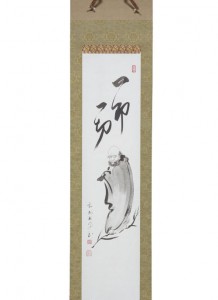
Juxtaposed as it is with the image of Bodhidharma, the implication is that he is the one who, by virtue of his awakened state of mind, has “no concerns today.”
Bodhidharma (Darumazu 達磨図)
Bodhidharma菩提達摩 or 菩提達磨
Chinese: Putidamo
Japanese: Bodaidaruma
was an Indian Buddhist monk, a meditation master who was active in China in the early sixth century and came to be revered as the founding patriarch初祖
of the Zen lineage禪宗
in that country. Very little is known about the historical Bodhidharma, but his legendary biography grew in detail from the eighth through the eleventh centuries, and he became an emblematic figure much invoked thereafter in Zen literature and art.
According to traditional accounts, the Zen lineage was founded when the Buddha Śākyamuni conveyed his awakening — his “subtle mind of nirvāṇa”涅槃妙心
, which is “signless”無相
— directly to one of his disciples, the monk Mahākāśyapa, in what is characterized as a “separate transmission”別傳
that took place “apart from the teachings”教外
of the sutras. Mahākāśyapa later transmitted the “buddha-mind”佛心
to another monk, Ānanda, who became the second patriarch of the Zen lineage in India. The “mind-dharma”心法
, as it was also called, was subsequently handed down from master to disciple through the generations until it reached Bodhidharma, the 28th patriarch, who was charged by his master Prajñātāra (the 27th) with transmitting it to China.
The lore about Bodhidharma’s career in China includes many famous incidents. He is said to have “come from the west” by sea, arriving in 527 C.E. He immediately had an audience with Emperor Wu of the Liang dynasty (502-557), whose avid patronage of Buddhist institutions he characterized as “having no merit”無功徳
. He then took up residence in the Shaolin Monastery少林寺
near Louyang, capital of the Northern Wei dynasty (386-535), where he spent nine years in meditation “facing a wall”面壁
. The monk Huike came to that monastery and was so ardent to be accepted as Bodhidharma’s disciple that he cut off his own arm斷臂
as an offering and was immediately instructed concerning true “peace of mind”安心
. Before returning to India, Bodhidharma recognized Huike as the second patriarch of the Zen lineage in China, stating that while other disciples had attained his “skin”皮
, “flesh”肉
,” and “bones”骨
, only the latter had “attained his marrow”得髓
. Bodhidharma, it is said, “only transmitted the mind dharma”唯傳心法
, no other teaching. With regard to his own method of instruction, he is often quoted as saying: “I point directly at the human mind吾直指人心
[so people may] see its nature and attain buddhahood見性成佛
,” and, “My method is to transmit mind by means of mind以心傳心
, without relying on scriptures不立文字
.”
Formal portraits of Bodhidharma (and all later patriarchs in his lineage) were first produced in Chinese Zen monasteries for use in annual and monthly memorial rites, when offerings of food and drink were made to those ancestral spirits. Later, all across East Asia, Bodhidharma also became an extremely popular subject of ink paintings inscribed with Zen sayings and used for decorative and didactic purposes. In keeping with his identity as an Indian monk, a “barbarian” from the west, he is conventionally depicted as a swarthy figure with a beard, earring, big nose, bulging eyes, and hairy chest. Moreover, in this ink painting by Zen master Takahashi, Bodhidharma’s body is outlined in a way that suggests the shape of the Chinese character for “mind” (心).