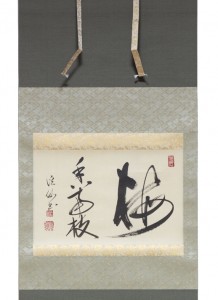
Line of Monks Gathering Alms

Inscribed Zen Sayings
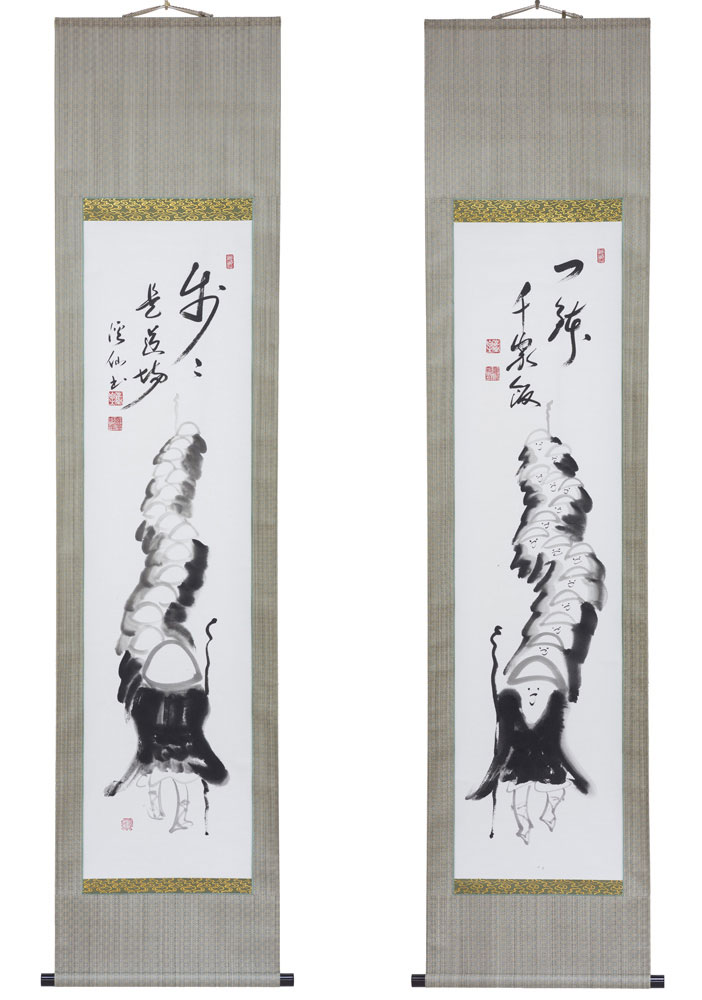
歩々是道場 (left scroll) 
Chinese: bu bu shi dao chang
Japanese: hoho kore dōjō
Translation: “Every Step is a Place of Practice”

一鉢千家飯 (right scroll)
Chinese: yi bo qian jia fan
Japanese: ippatsu senke no han
Translation: “In One Bowl, Rice from 1000 Households”

Gist of Sayings
In Zen, all aspects of human life, including such mundane activities as cooking, eating, cleaning and bathing, are regarded as equally good opportunities for spiritual development. That certainly goes for the traditional Buddhist practice of gathering alms托鉢
, in which monks humble themselves and give numerous lay householders the opportunity to create good karma by feeding them.
See full explanation ↓ 

Description of Item
・A paired set of hanging scrolls (kakejiku 掛軸) with images of a Line of Monks Gathering Alms (takuhatsu zu 托鉢図) — going out (ōro 往路) from the monastery (right) and returning (fukuro 復路) to the monastery (left), separate calligraphic Zen sayings (ji 字), identical artist’s signature and seals (in 印)
・Half Cut (hangiri 半切) style (inscription above image, reads top to bottom, right to left)
・Overall dimensions: each 18 inches x 78 inches (46 cm x 200 cm)
・Hand mounted using double layer damask silk brocade (nichō hon donsu 二丁本緞子), ceramic spindle tips
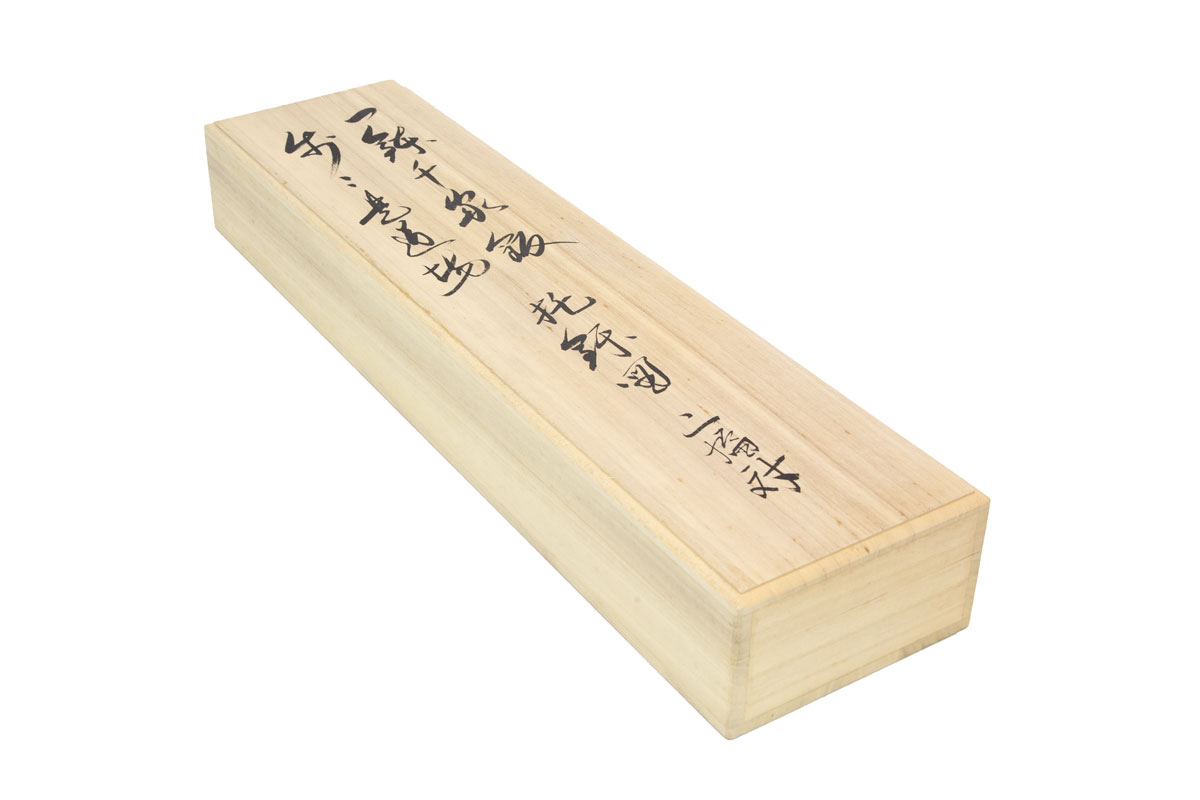
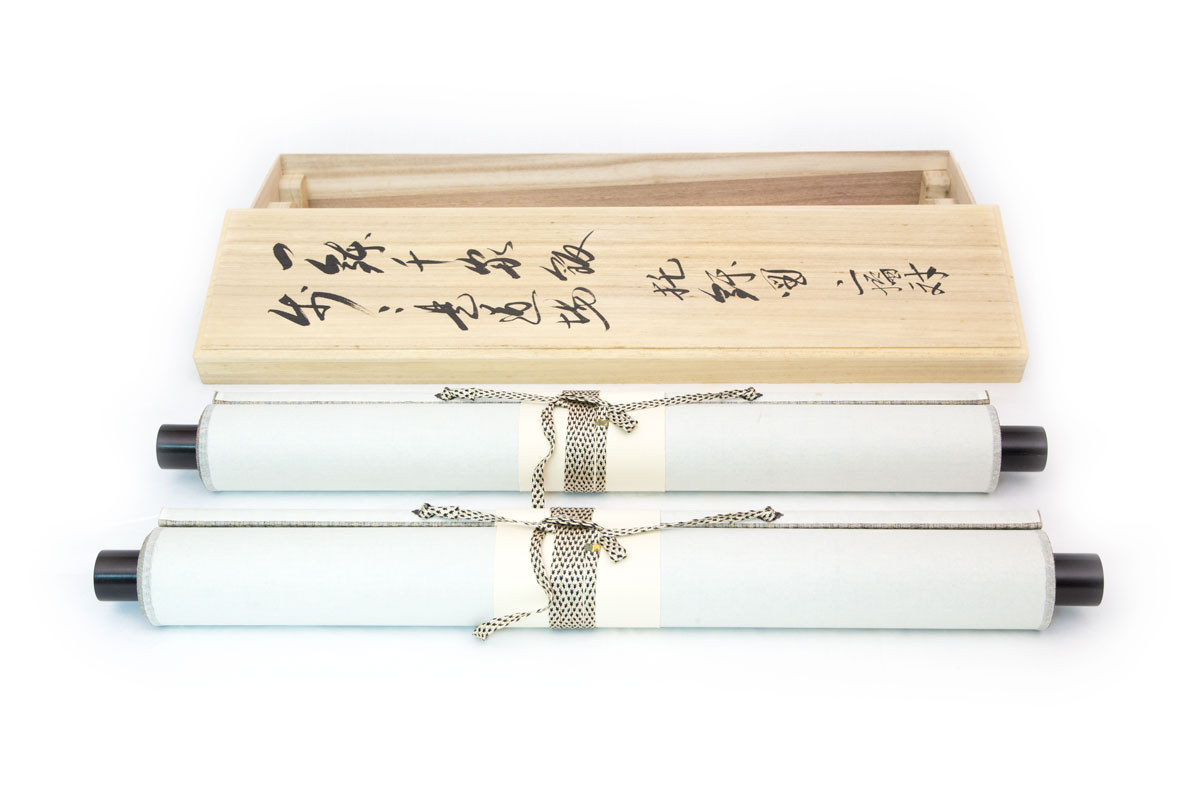
・Comes in paulownia wood (kiri 桐) storage box, inscribed by artist


$3,600.00

Available

“In One Bowl, Rice from 1000 Households” (一鉢千家飯)

(Right scroll)

This saying comes from a Chinese Buddhist poem that expresses the feelings of a wandering monk subsisting on alms:

In one bowl, rice from 1000 households;
all alone, I have wandered for 10,000 leagues.
These way-seeking eyes see few people;
to ask directions, I turn to the white clouds.

一鉢千家飯
孤身萬里遊
青目覩人少
問路白雲頭

In Chinese Buddhist literature, this poem is attributed to Budai布袋, literally “cloth sack”
Japanese: Hotei
, an eccentric monk of the ninth century who is said to have come from the Fenghua district奉化縣
of Mingzhou明州
. In art and legend, Budai is depicted as a pot-bellied, dishevelled figure carrying a staff with a cloth sack attached. He is said to have begged for food as he wandered about, slept out in the open, and excelled at fortune telling. In some accounts, Budai is said to be an incarnation of the bodhisattva Maitreya彌勒
, to whom the poem is also attributed.

The poem operates at two levels of meaning. On the literal level, it relates the experience of a wandering monk who has in the past received alms food from a great many lay households, but has has now traveled far into a remote region that is scarcely inhabited. On the metaphorical level, the poem suggests that at the outset of his spiritual quest, the monk was able to receive guidance from many different teachers. However, his understanding has developed to the point where there are very few people whose wisdom is greater than his, and who are thus able to guide him on his spiritual quest. He is on his own, and has only drifting clouds to show him which way to head.


“Every Step is a Place to Train” (歩々是道場)

(Left scroll)

According to the Discourse Record of Venerable Zhaozhou趙州和尚語錄
, a famous Zen text that features the sayings of Zhaozhou Congshen (778–897), this saying appears in the Vimalakīrti Sūtra:

The master [Zhaozhou] asked a prelate, “What [Buddhist] practices have you engaged in?” [The prelate] said, “I lecture on the Vimalakīrti Sūtra.” The master said, “The Vimalakīrti Sūtra says, ‘Every step is a place of practice.’ What place are you in?” [The prelate] had no reply.

師問座主所習何業云講維摩經師云維摩經步步是道場座主在什麼處無對。

 A “place of practice”道場
Chinese: dao chang
Japanese: dōjō
is a monastery or other site, permanent or temporary, that is set up to facilitate any sort of Buddhist practice or ritual performance. What the saying attributed to the Vimalakīrti Sūtra means is that wherever one happens to roam, footstep by footstep, that is one’s own “place of practice.” The saying does not actually appear in any Chinese translation of the Vimalakīrti Sūtra that is extant today, but the sentiment is a common one in Mahāyāna Buddhist literature.


Line of Monks Gathering Alms (takuhatsu zu 托鉢図)

Buddhist monks in ancient India collected alms food by walking in a line past the houses of lay people, holding up their begging bowls. If any householders wished to share what they themselves were eating, they would come out from their homes and put some food in the monks’ bowls. In Japan today Zen Buddhist monks still gather alms from lay people in the much the same fashion, in a practice that is called “holding up the bowl”托鉢
Japanese: takuhatsu
. They dress in the traditional outfit of the wandering monk行脚僧
Japanese: angya sō
, who carries a staff and wears a large wicker rain hat, leggings, and straw sandals. Forming a line (only the leader and rear guard hold staffs), they walk through residential and shopping districts shouting “Dharma rain!”法雨
Japanese: hō u
to announce their presence and solicit alms, which may take the form of foodstuffs (e.g. uncooked rice) or cash, depending on local custom. The alms are usually received and carried in a bag worn around the neck, which takes the place of a begging bowl held in the hands. The meaning of the shout “Dharma rain!” is that the monks are giving everyone an equal opportunity to make a donation and earn spiritual merit功德
Japanese: kudoku
, like the rain that falls freely and indiscriminately over a wide area and sustains all forms of life.

The right scroll shows a line of Zen monks going out往路
Japanese: ōro
from a monastery on their alms-gathering rounds. The left scroll shows the same monks returning復路
Japanese: fukuro
to the monastery.

Calligraphic Signature

(Left scroll only)
“Written by Keisen” (Keisen sho 渓仙書)
Keisen is Master Takahashi’s ordination name.

Comment Seal

“Ah ha ha!” (a ha ha 阿呵々)
The sound of laughter, as elicited by a good joke.
In-Ahaha

Signature Seals

“Abbot of Banshō Mountain” (Banshōzan shu 萬松山主)
Banshō is the “mountain name” of Daian-ji, Master Takahashi’s temple.
In-Banshozanshu2
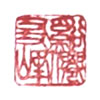
“Keisen Yūhō” (渓仙友峰)
Keisen Yūhō is Master Takahashi’s full Buddhist monk name.
In-Keisen-Yuhou
“Yūhō” (友峰)
Yūhō is Master Takahashi’s personal name.
In-Pot


Blarga