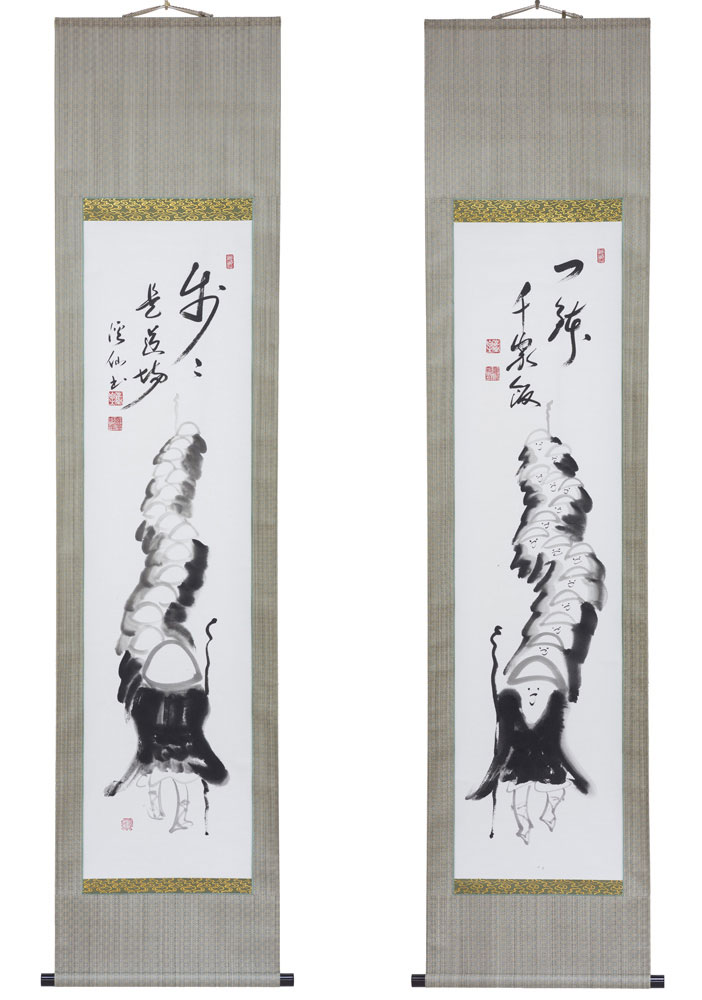
“In One Bowl, Rice from 1000 Households” (一鉢千家飯)
(Right scroll)
This saying comes from a Chinese Buddhist poem that expresses the feelings of a wandering monk subsisting on alms:
|
|
In Chinese Buddhist literature, this poem is attributed to Budai布袋, literally “cloth sack”
Japanese: Hotei
, an eccentric monk of the ninth century who is said to have come from the Fenghua district奉化縣
of Mingzhou明州
. In art and legend, Budai is depicted as a pot-bellied, dishevelled figure carrying a staff with a cloth sack attached. He is said to have begged for food as he wandered about, slept out in the open, and excelled at fortune telling. In some accounts, Budai is said to be an incarnation of the bodhisattva Maitreya彌勒
, to whom the poem is also attributed.
The poem operates at two levels of meaning. On the literal level, it relates the experience of a wandering monk who has in the past received alms food from a great many lay households, but has has now traveled far into a remote region that is scarcely inhabited. On the metaphorical level, the poem suggests that at the outset of his spiritual quest, the monk was able to receive guidance from many different teachers. However, his understanding has developed to the point where there are very few people whose wisdom is greater than his, and who are thus able to guide him on his spiritual quest. He is on his own, and has only drifting clouds to show him which way to head.
“Every Step is a Place to Train” (歩々是道場)
(Left scroll)
According to the Discourse Record of Venerable Zhaozhou趙州和尚語錄
, a famous Zen text that features the sayings of Zhaozhou Congshen (778–897), this saying appears in the Vimalakīrti Sūtra:
The master [Zhaozhou] asked a prelate, “What [Buddhist] practices have you engaged in?” [The prelate] said, “I lecture on the Vimalakīrti Sūtra.” The master said, “The Vimalakīrti Sūtra says, ‘Every step is a place of practice.’ What place are you in?” [The prelate] had no reply.
師問座主所習何業云講維摩經師云維摩經步步是道場座主在什麼處無對。
A “place of practice”道場
Chinese: dao chang
Japanese: dōjō
is a monastery or other site, permanent or temporary, that is set up to facilitate any sort of Buddhist practice or ritual performance. What the saying attributed to the Vimalakīrti Sūtra means is that wherever one happens to roam, footstep by footstep, that is one’s own “place of practice.” The saying does not actually appear in any Chinese translation of the Vimalakīrti Sūtra that is extant today, but the sentiment is a common one in Mahāyāna Buddhist literature.